Well, I wasn’t sure what to write for my next blog, but this one was kind of thrown at me as one I couldn’t really ignore. The importance of discussing issues related to the Equality Law has become increasingly evident in recent times, yet I have always hesitated to delve into these topics myself. I am a Para surfer for Team England, been around many wheelchair sports since breaking my neck, representing Great Britain in wheelchair rugby at the world championships, The development director for Great Britain Wheelchair Rugby, Represented British Athletics at the London London Para championships in 2017, and currently the surfing spoils me by being surrounded by people who love to help, give back, and who inclusion is not a second thought. Now and again I meet the exact opposite and it is just a stark reminder of my place in wider society as a whole.

I NEVER write posts regarding the Equality Law or subjects around it, even though I have dedicated years to improving online booking systems for accessible rooms in hotels. Despite my background, I rarely engaged in discussions about accessibility rights and regulations. However, after being hugely disappointed by a local revamped venue that I was very fond of and then being denied access to it, I feel compelled to share my experience and insights. It’s frustrating to see how the very places that should be welcoming to everyone can still fall short of meeting the needs of individuals with disabilities. This incident has opened my eyes to the broader implications of the Equality Law and the pressing need for awareness and change in our communities, more so now than ever it would seem. Therefore, in this blog and situation I am going to make my voice heard and advocate for what should be a fundamental right for all, in a venue of this size and capacity.
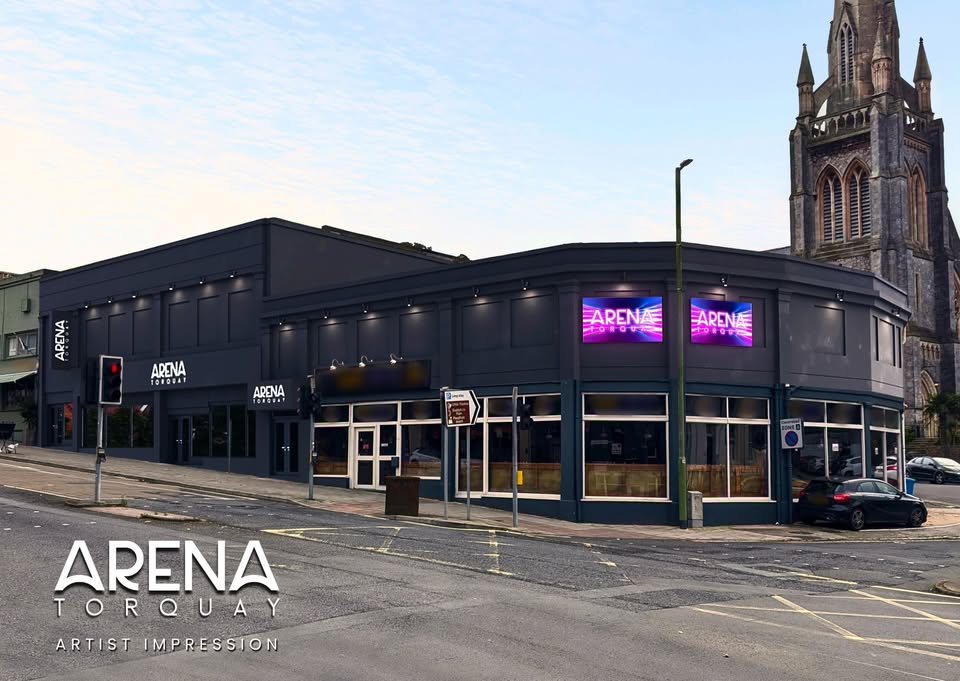
Image taken from the Arena public Facebook page
Their video shows their lift, too: https://www.facebook.com/share/v/1B5UYcMttu/
I asked the venue if they wanted to write a comment I could include with my blog about why they think they do not need to comply with Equality Act but they failed to respond.
I live in Torbay, a very old school tourist area which is trying to modernise but littered with listed buildings, old buildings and just plain inaccessible buildings, beautiful to many, a pain in the backside to others. Since breaking my neck in 1999 and living life 21 years able-bodied, I soon came to accept that people were never meant to be in wheelchairs; we were born with legs and therefore there are just some places, no matter how frustrating, that I just cannot expect access to. However, as I navigate through these challenges, I often reflect on the growing awareness around accessibility and the importance of inclusivity in our communities. In my time, I have been carried in and out of just about any kind of venue, literally friends booting me through narrow doorways to force my chair through, into some quite ridiculous scenarios, to be fair, which has also forged strong bonds of camaraderie among my friends to say the least! Yet it also begs the question of why, in this day and age, should I just have to accept that? Are we not meant to be a more enlightened society that appreciates the worth of everyone, no matter their race, religion, gender or disability? It seems perplexing to me that, despite advances in many areas, the basic right to access remains a challenge for so many, and still a forced issue for businesses.
I live in an old fishing village where 75% of local shops, pubs, restaurants, and businesses are not wheelchair accessible. I pass shops on the same street; some have level access while others seem to display a virtual ‘disabled people not welcome’ sign by still having a step and no thought to accessibility. What really gets my blood boiling is that new businesses ignore wheelchair access even while gutting and rebuilding from scratch—equal access should be a priority in the planning approval stage. The Equality Act 2010 seems ineffective; if it were effective, 25% of my town would be wheelchair inaccessible, not 75%.
What got my back up and made me write this post is recently being told I cannot go to a gig at a brand new club/venue/event space/kitchen and grill in Torquay, now called The Arena. It is on Torwood Street and used to be called, in my favourite era; ‘Claire’s Nightclub’. This iconic venue has been transformed, yet it still holds a special place in the hearts of many who remember the good old days. It is an upstairs venue (up about 10 steps, then walk way, then another 10 or so) based on two levels—with about 5 steps between the upper and lower rooms, which, to many, offered a unique vantage point to enjoy the vibrant atmosphere or either room. Fridays in the 90s were electric, filled with the biggest house DJs spinning tracks that got everyone raving; Saturday nights were a celebration of carwash disco and funk, and they were, without a doubt, the best nights in the 90s in Torquay. The nostalgia is palpable, and I know the place like the back of my hand; from the layout to the hidden corners where friendships blossomed and memories were made. As an able-bodied reveller, I walked up and down those stairs hundreds of times, danced in every part of the two floors, letting the music weave through my soul. Even after I broke my neck, the then owners Adrian and Jackie had zero issue with my friends or the bouncers carrying me up the stairs so I could continue where I left off! It was a community that looked out for one another—a spirit that defined the club—where random clubbers, friends, or bouncers would happily carry me between floors or back out of the venue without a second thought, embodying the essence of that era, which was so vital in such vibrant spaces. Each memory is a testament to the unbreakable respect between the venue and its patrons that encouraged bonds, euphoria, and a sense of belonging.
The place has been closed for years, so when I saw it had been bought and was being revamped, I was really pleased as it was such a great place with a vibrant history that celebrated countless unforgettable nights. Even more so when I saw it was opening with one of those legendary DJs from my era, ‘Paul Oakenfold’, whose beats had once filled the dance floor and created an electric atmosphere. Of course, I bought tickets without question, prior to opening, eagerly anticipating the night. Before I bought tickets, I even emailed the venue regarding accessibility; they sent a strong reply saying how committed they were to solving it, which made me even more hopeful and grateful that everyone could enjoy the experience. Literally, all of my friends from back in the day would be going—a real chance to catch up and reminisce with people I have known from school, and better still, people who I will have met on such nights out in Claire’s and not seen for years. The thought of reconnecting with those old acquaintances, sharing stories and laughter, and perhaps reliving some of those epic moments from our younger days filled me with excitement. Excited with anticipation for such a cracking night for all of us is an understatement, as I could already envision the liveliness of the crowd, the pulsating music, and the priceless memories waiting to be created once more.
So, you can imagine my utter scepticism when I emailed again just two weeks before opening to inquire about accessibility, only to be met with the excuse that it was too difficult to provide and to refund my ticket! I was left dumbfounded—how can a venue that claims to be fully revamped for 1200 people neglect to provide any wheelchair access? To my knowledge, they haven’t even installed a disabled toilet. Stairs issue: I know very well since I’ve navigated them both on foot and while being carried; they aren’t steep, difficult, or impossible to modify. In a bid to lessen my dissatisfaction, I naively mentioned that my friends could carry me up the stairs without issue like they used to, but I asked for guidance on where the toilets were relocated. To my astonishment, I learned that the toilets had been moved downstairs, further distancing them from the main space (they previously had facilities on both levels). If their communication is accurate, it appears they’ve intentionally made the toilets even less accessible, failing to replace those five stairs with a long ramp for all to use to get to them between levels. Then, in that same chain of correspondence, they bluntly informed me that as a wheelchair user, I would not be allowed access to the venue. In 2025, that certainly feels like an egregious form of discrimination. No amount of reassuring phrases they offer about their supposed commitment to resolving accessibility issues can hide the fact that they are failing to cater to individuals with disabilities. They might as well hang a sign on the door saying, ‘wheelchair users not welcome, but maybe one day if we can be bothered.’ The irony is that even if they had a lift for wheelchairs specially fitted, they’d still have to carry me out in a fire as you can’t use lifts in fires?!
The pressing issue at hand is how such establishments are permitted to operate without accountability. How is it possible for a venue of considerable size, undergoing extensive renovations, to be granted a license and planning permission while lacking basic provisions for wheelchair access and even a suitable restroom for individuals with disabilities? Prior to 2010, there was considerable anticipation regarding the implementation of the Equality Act, intended to supplant the 1990 Disability Discrimination Act, and many believed it would signal significant progress. I had high hopes for its impact on my initiatives surrounding accessible hotel room bookings, as well as for the overall enforcement against businesses that failed to accommodate disabled patrons. However, it was disheartening to witness the government’s retreat from meaningful action, allowing businesses an escape clause through the inclusion of “reasonable adjustments.” Access would not become a stringent requirement as it is in the United States; rather, businesses were granted the latitude to argue that providing necessary access would be financially burdensome.
However, can a venue of this size, catering to so many people, truly justify the claim that making the building accessible is unreasonable? What really struck me was watching one of their promotional videos showcasing the flashy new equipment being delivered via an extravagant all-singing, all-dancing elevator/lift! Sure, it might be a goods lift not designed for passengers, and one could argue that installing a whole new lift just for a handful of wheelchair users is an unreasonable expense, but is it really too much to ask to have that goods lift adapted for disabled customers (which, by the way, is permitted)? It’s frankly quite appalling and would definitely be reasonable.
Now, as a disclaimer, I do not know where that lift is located in the building and how difficult everything around it is, I’m also going off of their email communication, but if they can wheel heavy equipment onto it and to where it needs to go, I am guessing a wheelchair should not be an issue! When you couple that with them ‘allegedly’ not providing a disabled toilet either and moving the toilets downstairs (about a dozen of my friends will let me know, I am sure); their argument that they have been trying to overcome the access issues and are committed to fixing it doesn’t hold much weight. This situation strikes at the heart of what equality and access truly mean, and it’s high time businesses large or small, or their landlords, recognize their responsibility to ensure their venues are welcoming to all individuals, regardless of their physical abilities. It is not just about compliance; it is about dignity, respect, and the recognition that everyone has the right to enjoy social spaces. I actually do not not understand how the relevant national or local authority signed off plans with no wheelchair access? I’ll tell you why, but the Equality Act is utterly useless in cases like this.
Do I wish this new venture ill will? Of course not! I truly hope it becomes a mega success, revitalizing that building and creating wonderful memories for everyone, just as it did for me and my friends. The point here is that wheelchair and disabled access should have been a priority in their planning. If it had been, the venue would be accessible to all. Perhaps the owners simply haven’t considered this aspect, as they may not know anyone who uses a wheelchair (I used to be in that position before my injury). It’s also possible that they believe they could argue under the Equality Law that providing access might be unreasonable for them. While this mindset is certainly disappointing, it highlights an area for growth and improvement. I remain hopeful that over time, attitudes will change, and the local authorities responsible for approving plans will embrace their role in fostering inclusivity, especially in a tourist area where many people coming and spending their money in restaurants, hotels and shops are older with mobility issues.
Even after 25 years, I am optimistic that the spirit of the Equality Act can be revitalised and truly make a difference.
Ha ha – I believe that last sentence about as much as I believe any politician these days.
 James A K Price - A Raspberry Ripple's Blog
Leave a comment